Passa ai contenuti principali

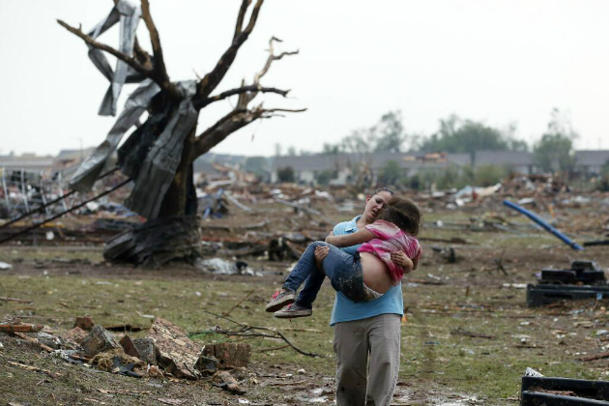
Massive tornado rips through Moore, Oklahoma: 51 killed, including 20 children


May 21, 2013 – 

OKLAHOMA - A devastating, two-mile-wide tornado touched down near Oklahoma City on Monday, killing at least 51 people—including at least 20 children—decimating homes, businesses and a pair of elementary schools in the suburb of Moore. According to the state's medical examiner, the death toll was expected to rise. The schools—Plaza Towers Elementary and Briarwood Elementary—were leveled by the tornado. It was unclear how many children were in them at the time the twister hit, but according to KFOR-TV, at least seven children died at Plaza Towers, and as many as two dozen more were feared to be trapped inside the rubble. An Associated Pressphotographer saw rescue workers pull several children out alive. A makeshift triage center was set up in the school's parking lot. “This is war-zone terrible,” Jon Welsh, a helicopter pilot for KFOR who lives in Moore, said while surveying the damage from the air. “This school is completely gone.” Emergency officials urged people to remain off the roads so rescue workers and first responders could reach people potentially trapped in rubble, as the National Guard was called in to help in the search for victims. Three people were killed at a 7-Eleven in the path of the storm, CBS' KWTV reported, including a man, woman and baby who took cover in a freezer but didn't survive. KFOR reported a fourth person was killed there. “Our hearts are broken,” Oklahoma Gov. Mary Fallin said at a news conference Monday evening. The tornado left a debris field 20 miles long and several miles wide. According to the National Weather Service in Norman, Okla., the tornado was on the ground for approximately 40 minutes, and a tornado warning was in effect for 16 minutes before the twister developed. Weather officials estimated the strength of the storm to be an F4 or F5 on the Fujita Scale—the highest rating a tornado can achieve. The National Weather Service said the tornado's preliminary classification was an F4, with winds up to 200 mph. On May 3, 1999, a tornado outbreak near Oklahoma City produced 14 tornadoes—including an F5 in Moore—killing 36 people and injuring 295 others. A host on KFOR called Monday's storm “the worst tornado damage-wise in the history of the world.” The devastated area was an estimated 30 square miles. “The whole city looks like a debris field,” Moore Mayor Glenn Lewis said on NBC's “Nightly News. Our hospital is pretty much destroyed.” Communication was snarled as landlines and cell phone towers were knocked down. A water treatment plant in Oklahoma City was also damaged. President Barack Obama directed the Federal Emergency Management Agency to prepare to get “all available assistance” to the disaster-hit area. –

Commenti

Post popolari in questo blog

Have mymonero some problems ?

Hello, this is user pandher from BTCtalk. I have been a follower and holder of Monero since 2014 when the first bitmonero thread appeared on BTCtalk. Since that thread i knew Monero was the only one worth following. The professionalism and honesty of the dev team was a rare sight in that shitcoin madness. Checking the Monero reddit page and speculation thread had become a morning habit with me. I rarely missed reading both of these in these 2 years. I saw the community grow from a few hundred to a few thousand. It was so good to watch, to witness. Although i was mostly non vocal i felt myself as a part of this community. Reading AP's posts about the new world domination were exciting. But today i bid farewell to this wonderful community. All my Monero have been stolen Since zhalox posted about his lost Monero, i woke up from my slumber and created a cold wallet using GingerAle's paranoid method. Only to find out all my 4 MyMonero accounts were wiped on 3 september 2016. I...

Dove le molecole smettono di Ur­tarsi: viaggio nella coerenza Quantistica della Vita

C’era un momento, nella storia della biologia, in cui la vita veniva immaginata come un enorme tavolo da biliardo. Molecole che si urtano. Collisioni casuali. Reazioni che accadono perché, semplicemente, qualcosa colpisce qualcos’altro nel modo giusto. Funzionava. Più o meno. Poi, lentamente, qualcosa ha iniziato a incrinarsi. Non perché quella visione fosse sbagliata, ma perché era incompleta. Troppo rumorosa. Troppo cieca. Troppo… inefficiente per spiegare ciò che osservavamo davvero. Perché dentro le cellule accadevano cose strane. Troppo veloci. Troppo precise. Troppo coordinate. Come se, invece di urtarsi alla cieca, le particelle… sapessero. Immagina di entrare dentro una cellula. Non troverai caos. Non troverai disordine. Troverai elettroni che scorrono come una valuta invisibile, scambiata con una precisione che sfida l’intuizione. Non saltano semplicemente da una molecola all’altra: a volte attraversano barriere che, secondo la fisica classica, non dovrebbero poter...

Ingegneria del contesto per l'intelligenza artificiale avanzata

  Quando si parla di IA generativa, il dibattito pubblico si concentra spesso su due aspetti: la potenza del modello e la qualità dei prompt. Tuttavia, tra questi due poli si trova un'area meno discussa ma cruciale:  il contesto  . Non stiamo parlando solo di "informazioni extra" per il modello, ma dell'architettura logica e operativa che determina il modo in cui l'intelligenza artificiale interpreta, collega e utilizza i dati per fornire risultati accurati e coerenti. È qui che entra in gioco  l'ingegneria del contesto  : l'arte (e la scienza) di progettare, organizzare e ottimizzare il contesto di un Large Language Model (LLM) per guidarlo verso risposte più affidabili, precise e utili. Perché l'ingegneria del contesto è importante Un LLM non "capisce" il mondo come gli esseri umani. Elabora modelli statistici in base agli input che riceve e ai dati di training.  Il contesto  è la combinazione di istruzioni, esempi, dati di supporto e rifer...