Passa ai contenuti principali

Tsunami reaches Hawaii after 7.7 earthquake strikes western Canada


October 28, 2012 – CANADA -
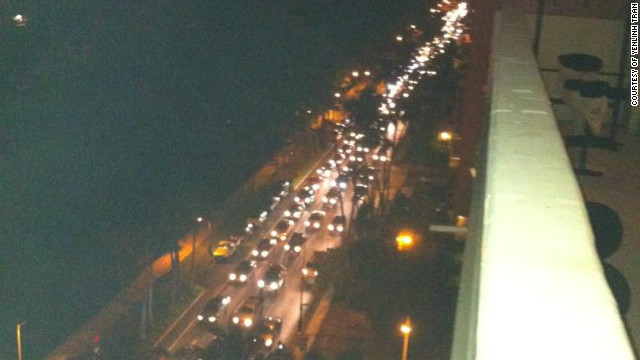

 After barreling across the Pacific Ocean for hours, a tsunami spawned by an earthquake in Canada struck the Hawaiian Islands. Waves between 3 and 7 feet were expected to lash the islands beginning about 10:28 p.m. Saturday (4:28 a.m. Sunday ET), the Pacific Tsunami Warning Center said. The first waves to hit Honolulu didn't seem much stronger than usual. But scientists said don't be fooled by the initial waves, which often aren't the biggest. “It's not just one wave, it's a succession of waves,” Gerard Fryer, senior geophysicist at the center, told reporters. “The following waves, I am sure, will be bigger.” But he noted that the tsunami will not be as significant as the devastating quake and tsunami that killed thousands in Japan in March 2011. Local television showed images of bumper-to-bumper traffic on roads leading from the coast to inner ground. About 80,000 people live in evacuations zones in the island of Oahu, the island where Honolulu is located. John Cummings, spokesman for Honolulu Emergency Management, said officials have opened 26 centers for evacuees. “All islands and all shorelines will be affected when it comes in,” Cummings said. Honolulu Mayor Peter Carlisle urged residents who are already on higher ground to not clog traffic. Officials expressed concerns about emergency vehicles getting by in heavy traffic. But the tsunami warning came at an unfortunate time -- when thousands of revelers packed streets in Honolulu for the annual Hallowbaloo festival. Even Hawaiians accustomed to tsunami warnings spared no effort in bracing for the worst. Honolulu resident Victoria Shioi filled her bathtub with water, set her refrigerator to the coldest setting and gathered candles in case of water or power outages. The tsunami was spawned by an earthquake in western British Columbia, prompting a local tsunami warning and sending some residents toward higher ground. “A (magnitude) 7.7 is a big, hefty earthquake -- not something you can ignore,” Fryer said. “It definitely would have done some damage if it had been under a city.” Instead, the quake struck about 139 kilometers (86 miles) south of Masset on British Columbia's Queen Charlotte Islands. No major damage was reported. The Alaska Tsunami Warning Center issued a warning for western British Columbia from Vancouver to the southern panhandle of Alaska. Canadians as far as Prince Rupert on mainland British Columbia felt the quake. –

http://edition.cnn.com/2012/10/28/world/americas/canada-earthquake/index.html?eref=igoogledmn_topstories

Commenti

Post popolari in questo blog

Have mymonero some problems ?

Hello, this is user pandher from BTCtalk. I have been a follower and holder of Monero since 2014 when the first bitmonero thread appeared on BTCtalk. Since that thread i knew Monero was the only one worth following. The professionalism and honesty of the dev team was a rare sight in that shitcoin madness. Checking the Monero reddit page and speculation thread had become a morning habit with me. I rarely missed reading both of these in these 2 years. I saw the community grow from a few hundred to a few thousand. It was so good to watch, to witness. Although i was mostly non vocal i felt myself as a part of this community. Reading AP's posts about the new world domination were exciting. But today i bid farewell to this wonderful community. All my Monero have been stolen Since zhalox posted about his lost Monero, i woke up from my slumber and created a cold wallet using GingerAle's paranoid method. Only to find out all my 4 MyMonero accounts were wiped on 3 september 2016. I...

Dove le molecole smettono di Ur­tarsi: viaggio nella coerenza Quantistica della Vita

C’era un momento, nella storia della biologia, in cui la vita veniva immaginata come un enorme tavolo da biliardo. Molecole che si urtano. Collisioni casuali. Reazioni che accadono perché, semplicemente, qualcosa colpisce qualcos’altro nel modo giusto. Funzionava. Più o meno. Poi, lentamente, qualcosa ha iniziato a incrinarsi. Non perché quella visione fosse sbagliata, ma perché era incompleta. Troppo rumorosa. Troppo cieca. Troppo… inefficiente per spiegare ciò che osservavamo davvero. Perché dentro le cellule accadevano cose strane. Troppo veloci. Troppo precise. Troppo coordinate. Come se, invece di urtarsi alla cieca, le particelle… sapessero. Immagina di entrare dentro una cellula. Non troverai caos. Non troverai disordine. Troverai elettroni che scorrono come una valuta invisibile, scambiata con una precisione che sfida l’intuizione. Non saltano semplicemente da una molecola all’altra: a volte attraversano barriere che, secondo la fisica classica, non dovrebbero poter...

Ingegneria del contesto per l'intelligenza artificiale avanzata

  Quando si parla di IA generativa, il dibattito pubblico si concentra spesso su due aspetti: la potenza del modello e la qualità dei prompt. Tuttavia, tra questi due poli si trova un'area meno discussa ma cruciale:  il contesto  . Non stiamo parlando solo di "informazioni extra" per il modello, ma dell'architettura logica e operativa che determina il modo in cui l'intelligenza artificiale interpreta, collega e utilizza i dati per fornire risultati accurati e coerenti. È qui che entra in gioco  l'ingegneria del contesto  : l'arte (e la scienza) di progettare, organizzare e ottimizzare il contesto di un Large Language Model (LLM) per guidarlo verso risposte più affidabili, precise e utili. Perché l'ingegneria del contesto è importante Un LLM non "capisce" il mondo come gli esseri umani. Elabora modelli statistici in base agli input che riceve e ai dati di training.  Il contesto  è la combinazione di istruzioni, esempi, dati di supporto e rifer...